The modern academic landscape is increasingly intersectional. For students in Canada assignment help — from those navigating Grade 12 Advanced Functions in Ontario to university students at UofT or UBC tackling complex algorithms—the pressure to maintain a high GPA while developing industry-ready coding skills is immense.
In a world where digital literacy is as fundamental as reading and writing, learning to code is no longer just for computer science majors. Whether you are aiming for a career in finance, engineering, or even the arts, technical proficiency is the “X-factor” on a resume. However, the primary challenge remains: how do you find the time to master Python, Java, or C++ when you have a stack of essays, lab reports, and midterms looming?
This comprehensive guide explores strategic ways to sharpen your programming proficiency without compromising your academic standing.
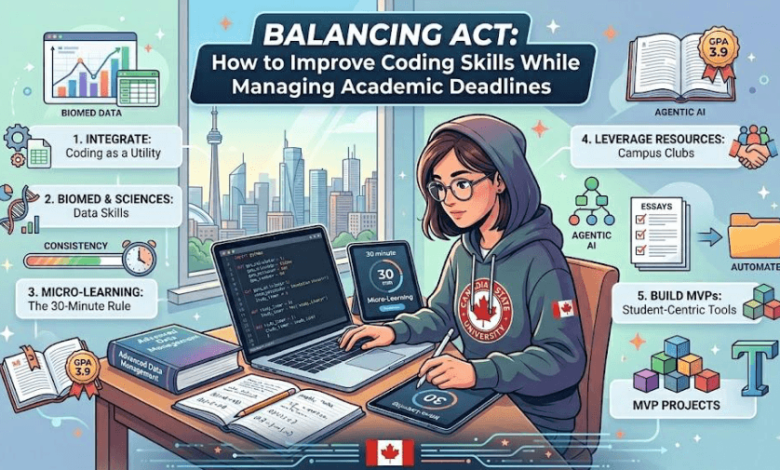
1. The Integration Strategy: Coding as a Tool, Not a Task
The most effective way to improve your coding skills is to stop treating programming as a separate hobby and start viewing it as a utility for your current studies. This shift in mindset reduces cognitive load because you are no longer “finding time” to code; you are using code to save time.
Automate Your Academic Workflow
If you are a high school student working through the data management curriculum or a university student in British Columbia analyzing social statistics, you can use coding to simplify your workload. Instead of using a standard calculator or spreadsheet for repetitive tasks, write a simple Python script. If the logic becomes too complex for a single study session, seeking specialized Python assignment help can provide the structural guidance needed to debug your scripts and understand advanced libraries.
- Example: Create a script to calculate your weighted GPA based on different credit weights or a program to format your bibliography according to APA or MLA standards.
- The Benefit: You are practicing syntax and logic while solving a real-world problem that directly impacts your academic efficiency.
2. Bridging the Gap: Technical Literacy in Health and Sciences
For students studying within the health sciences or medical fields—a popular path across Canadian institutions like McMaster, McGill, or Dalhousie—the intersection of technology and healthcare (Bioinformatics) is a massive growth area. Improving your coding skills isn’t just about software; it’s about sophisticated data management.
Understanding how to use Python for large-scale data analysis or using R for statistical modeling in clinical trials can set you apart in a competitive field. Even a basic understanding of how databases are structured helps in navigating Electronic Health Records (EHR).
Coding for Pre-Med and Medical Students If you are preparing for the MCAT or currently in medical school, building a simple diagnostic flowchart tool or a medication tracker can serve as both a study aid and a coding project. Furthermore, many Canadian medical research internships now prioritize candidates who can perform their own data scrubbing and visualization using tools like Pandas or Matplotlib. Learning to automate the sorting of research papers or clinical data can save hundreds of hours during a residency or a PhD program.
3. Micro-Learning and the Power of Consistency
One of the biggest mistakes students make is waiting for a “free weekend” to dive into a coding project. Between part-time jobs and heavy course loads, those weekends rarely stay free.
The 30-Minute Rule Research into cognitive load suggests that consistent, short bursts of learning are more effective for syntax retention than infrequent “cram sessions.” Dedicate just 30 minutes a day to a platform like LeetCode or HackerRank.
- Morning Routine: Solve one logic puzzle while having breakfast.
- Commute Time: If you are taking the TTC in Toronto, the SkyTrain in Vancouver, or the LRT in Ottawa, use that time to read documentation or listen to a programming podcast.
- The Compounding Effect: By spending 30 minutes daily, you accumulate over 180 hours of practice a year—equivalent to several university-level courses.
4. Leveraging Academic Resources for Professional Growth
As a student, you have access to a wealth of resources that often become expensive once you graduate. You should view your institution as a subsidized incubator for your technical skills.
Utilize Campus Coding Clubs Most Canadian institutions, from secondary schools to major universities, have active developer communities. Joining a club provides:
- Accountability: It is easier to stick to a learning path when you have peers doing the same.
- Collaborative Learning: Explaining a concept to a classmate is one of the fastest ways to solidify your own understanding (the Feynman Technique).
- Networking: Many clubs host hackathons or “code jams” sponsored by local tech giants or startups in the Waterloo-Toronto tech corridor, providing a bridge to a future career.
Managing the Academic Overflow When academic deadlines become overwhelming, it is important to know when to seek external support to maintain your momentum. Managing heavy course loads with expert assignment help in Canada can provide the breathing room needed to focus on your technical development without letting your GPA slip. Whether it’s getting a second pair of eyes on a complex case study or seeking guidance on a difficult mathematical theorem, managing your time effectively often means delegating or seeking expert clarification to stay on track.
5. Building a “Minimum Viable Project” (MVP)
Instead of trying to build the next major social media platform, focus on building small, functional tools that solve immediate student problems.
Ideas for Student-Centric MVPs:
- A Smart Study Timer: A custom Pomodoro app that tracks your study sessions and exports the data to a CSV file for progress tracking.
- Automated Flashcard Generator: A program that parses your digital notes and turns them into flashcards for Anki or Quizlet.
- Grade Predictor & Goal Setter: A tool that calculates exactly what percentage you need on your final exam to reach a specific target grade, accounting for weighted totals.
6. The 2026 Career Outlook: Why Coding is Non-Negotiable
The Canadian job market in 2026 has shifted. Employers are no longer looking for “pure” specialists; they want “T-shaped” professionals. This means having deep expertise in one area (like Biology or Finance) and broad skills in another (like Data Science or AI literacy).
As Agentic AI begins to automate routine tasks, the value moves to those who can direct these AI agents. Understanding the logic behind the code allows you to troubleshoot AI outputs and create custom workflows that a non-technical peer simply cannot replicate.
See also: Medicare Costs: Premiums, Deductibles and Out-of-Pocket Expenses Explained
Frequently Asked Questions
Q.1 Can I get high school credits for learning to code in Canada?
Yes. Many provinces offer specific courses, such as Ontario’s ICS3U (Grade 11) and ICS4U (Grade 12) Computer Science credits. Additionally, some schools allow for “External Credits” if you complete certified coding programs outside of the standard curriculum.
Q.2 Which programming language should a Canadian student start with?
Python is widely recommended due to its readable syntax and its heavy use in Canadian university data science and engineering programs. However, if you are interested in web development, JavaScript is essential. For those in heavy math or stats, R is a strong contender.
Q.3 How do I balance coding with a part-time job and full-time studies?
Use the “Integration Strategy.” If your part-time job involves data entry or administrative work, look for ways to automate small parts of it using scripts (with permission). This turns your work hours into paid practice hours.
Q.4 Are there free coding resources for students in Canada?
Absolutely. Beyond platforms like FreeCodeCamp, many Canadian libraries (like the Toronto Public Library or Vancouver Public Library) offer free access to LinkedIn Learning and other premium technical tutorial sites with a valid library card.
Q.5 Will coding skills help me if I’m not a Computer Science major?
Definitely. Modern roles in Marketing, Healthcare, and Finance prioritize candidates who can communicate with dev teams and understand data structures. It makes you a more versatile and hireable professional.
Conclusion
Improving your coding skills while managing academic deadlines is not about working harder; it is about working smarter. By integrating code into your daily studies, maintaining a consistent micro-learning schedule, and utilizing academic support when necessary, you can build a formidable skill set that complements your degree. Remember, in the digital economy, your ability to speak the language of machines is your greatest competitive advantage.
About the Author
Drake Miller is a senior content manager and academic strategist based in Canada with over 12 years of experience. He specializes in the ethical integration of Agentic AI within education, blending pedagogical theory with technical programming expertise. From automating content workflows to designing AI-driven frameworks, Drake ensures innovation is both scalable and academically sound.